

County Leaders Meet with Legislators, Administration to Highlight H.R. 1 Impacts
Back to News
Other than education funding protected under Proposition 98, H.R. 1 now stands as the single largest structural issue facing California’s state budget – with major consequences for the counties responsible for delivering many of the state’s core safety net services. The sweeping federal policy shifts threaten to reshape the state’s fiscal outlook and could cost counties billions each year, making it one of the most significant budget challenges California leaders have faced in decades.
CSAC convened California county leaders in Sacramento this week for an H.R. 1 Education Day to inform state legislators and Administration officials on the local impacts of H.R. 1, which are estimated to cost counties up to $9.5 billion annually at full implementation. County supervisors were joined by representatives from the California Association of County Executives (CACE), County Health Executives Association of California (CHEAC), California Association of Public Hospitals (CAPH), County Welfare Directors Association (CWDA), and County Medical Services Program (CMSP) to explain how federal changes are creating significant fiscal challenges for local governments that administer and deliver critical health and human services programs.



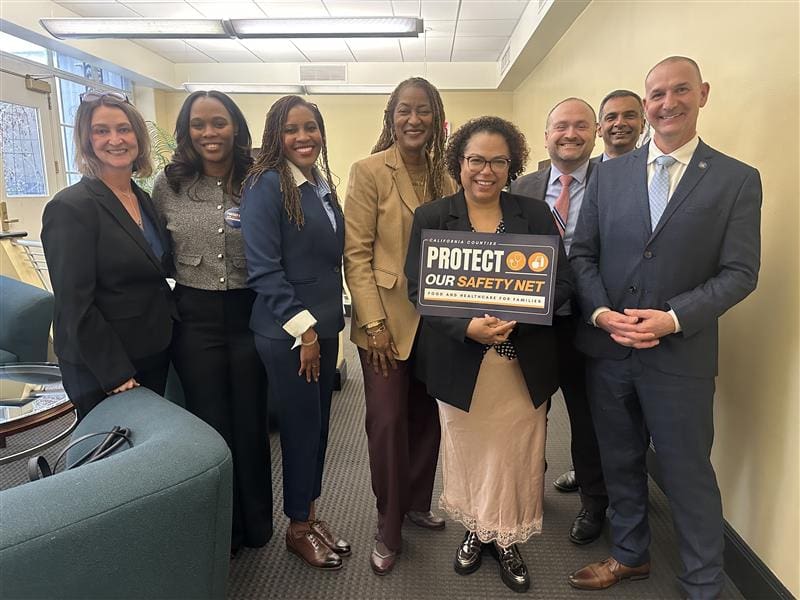

Counties are legally mandated to administer core safety net programs – from eligibility determinations for Medi-Cal and CalFresh to operating public health clinics and indigent health care programs – under state and federal law. But without funding, Santa Clara County Supervisor and CSAC President Susan Ellenberg notes, “we will be challenged to continue to provide healthcare and this impact will cascade.”
The loss of coverage could push communities back toward reliance on indigent care programs. “Most of our legislators don’t remember a time when counties weren’t funding indigent care,” President Ellenberg explained. “Even at its best, indigent care is very subpar compared to Medi-Cal. It’s the care of last resort.” Leaders also cautioned that reduced coverage will drive up uncompensated care and emergency department use. “We’re going to see high uncompensated care, high ER visits… preventative care is going to go away,” said Tulare County Chief Administrative Officer Jason Britt, noting that some hospitals estimate losses of “tens of millions a month in lost local revenue.”
County leaders had a full day of meetings with legislators who chair key budget and policy committees, as well as the Governor’s Legislative Affairs Secretary Christine Aurre, the California Health and Human Services Agency Secretary Kim Johnson, and the Department of Finance Director Joe Stephenshaw. Throughout the day, counties emphasized the need for ongoing collaboration with the Legislature. “It’s significant to see the number of organizations represented at this table. We are working together, and we need the Legislature to be our partner as well,” Ellenberg said. Monterey County Supervisor and CSAC 1st Vice President Luis Alejo added that the challenge will require sustained engagement, “We’re looking at this as a multiyear structural problem that needs to be worked and negotiated with the Legislature.”
County leaders made clear they are committed to working with state leaders to identify solutions that are structural, sustainable, and sufficient to protect the safety net. Without state action and support, California’s safety net is at risk of crumbling. As Los Angeles County Supervisor and CSAC Health and Human Services (HHS) Policy Committee Chair Holly Mitchell put it, “In effect the rug has been pulled out from under us.”