
County Spotlight: In San Diego County, a Safety Net Bridge Built Together
Back to News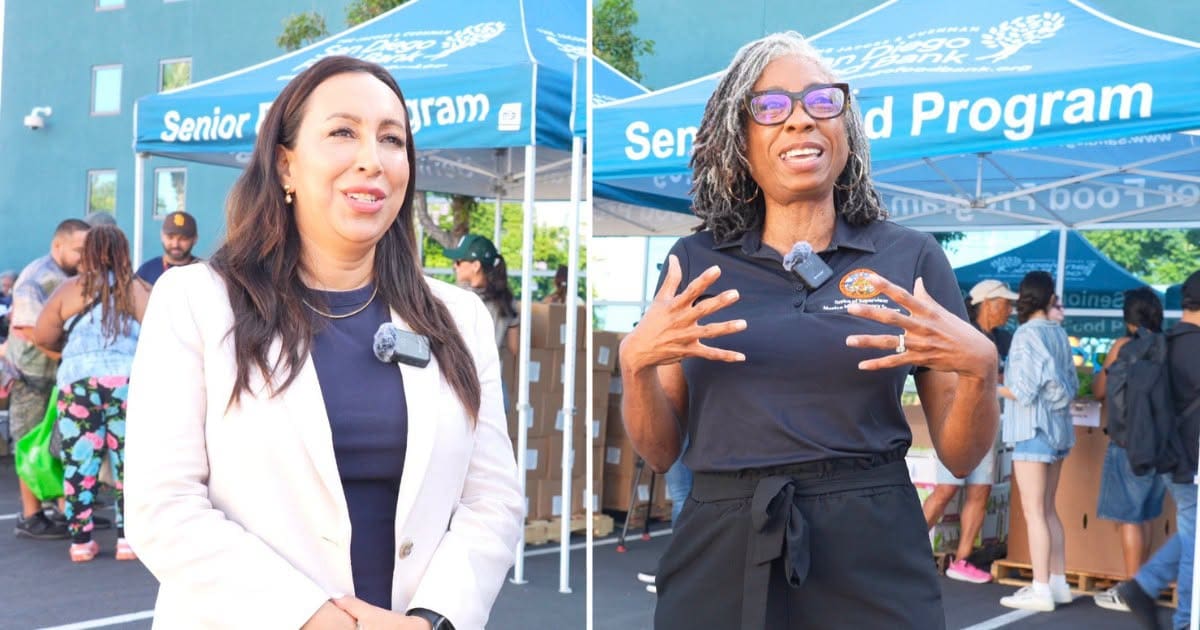
By the time the morning sun reached the South Region Live Well Center in San Diego County, the parking lot was already alive with purpose. Neighbors waited with carts and reusable bags. Volunteers opened boxes of shelf-stable food and sorted cucumbers, apples, and bright green peppers. Nearby, County of San Diego eligibility workers sat across from residents, ready to answer questions and help ensure they’re enrolled in CalFresh and Medi-Cal.
San Diego County Supervisor Monica Montgomery Steppe, who spearheaded the Safety Net Bridge Program, simply wanted to do what counties do best: bring government, community organizations, and neighbors together around the people who need help most.
The August 8 event was the first in a year-long series created in response to H.R. 1, the federal law that tightened eligibility and work-reporting requirements for public benefits. Those changes have put an estimated 93,500 San Diego County residents at-risk of losing some or all their CalFresh food assistance. Additional Medi-Cal changes are expected to impact hundreds of thousands of residents.
Supervisor Paloma Aguirre, in whose district the event took place, pointed out that families are facing dire socio-economic situations. ““More and more, we’re seeing the new class, which is the working poor, and people who depend on these programs to be able to rely on wellbeing.”
For families facing that uncertainty, the event offered two kinds of support. The Jacobs & Cushman San Diego Food Bank distributed fresh produce. At the same time, county staff helped residents apply or reapply for CalFresh and Medi-Cal, understand the new rules and connect with other resources.
That pairing was intentional. Food for today mattered, but so did helping residents preserve access to the benefits that can provide stability tomorrow.
Supervisor Montgomery Steppe described the stakes plainly. “People are hungry. And at the beginning of next year, they’re going to experience ineligibility around Medicaid. But we are working hard to mitigate that.”
The County Board of Supervisors approved $1 million for the food distribution effort in June. Working with the San Diego Food Bank and Feeding San Diego, the County plans regular events at six locations across the county through August 2027, focusing on communities expected to be most impacted by the federal changes. The first event served more than 500 people with food and resources.
The response reaches beyond food distribution. A WorkReady Hub developed with 211 San Diego connects people with opportunities to meet new work requirements. The County has also created outreach presentations, a community toolkit, and a Federal Impacts Assistance Hub to help residents and local organizations understand what is changing.
San Diego Food Bank CEO Casey Castillo noted that the need grows quickly when public support recedes: “Historically when there is a pullback in government benefits, it drives people to food pantries.”
That reality was visible on the ground in San Diego County, but so was the strength of the response. County employees worked alongside food bank teams. Volunteers packed boxes, handed out produce and helped people move their groceries. Residents received assistance in a familiar county space, with multiple services gathered in one place. What could have felt like a maze of new rules instead became a welcoming front door.
The visit offered a real view of county leadership in action. The work was practical and immediate, but it also carried a larger message: Counties are where policy changes become real for people, and where public servants build solutions around those realities.
Supervisor Montgomery Steppe captured the spirit behind the effort. “Everyone should be able to eat, and no one should go hungry. That’s really the bottom line. It should be all of our goals at the federal, state and local level that no one should go hungry.”
At the first Safety Net Bridge event, that action looked like a box of groceries, a benefits application, a patient’s answer, and a volunteer’s outstretched hand. Together, those moments formed something larger: a community refusing to let its neighbors face change alone.