

LegCon 2026: HHS Secretary Kim Johnson Highlights Behavioral Health Progress, H.R. 1 Challenges
Back to News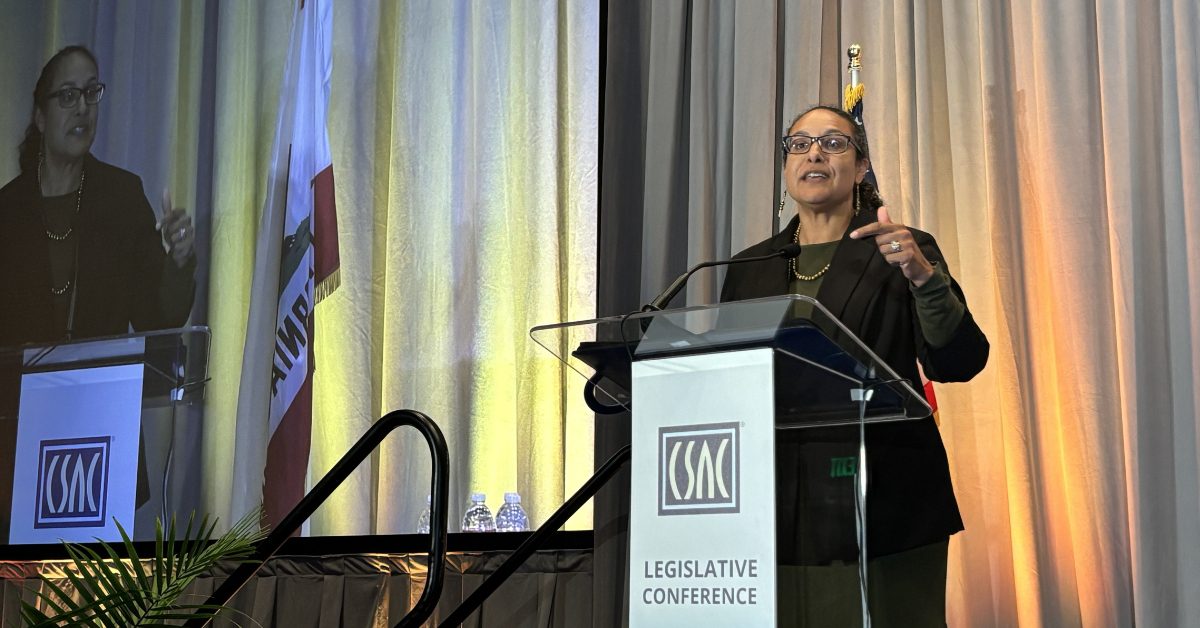
California Health and Human Services Secretary Kim Johnson highlighted California’s ongoing behavioral health reforms and the state’s efforts to mitigate H.R. 1’s impact on critical safety net services as she addressed CSAC’s 2026 Legislative Conference on Wednesday
“We are here in true faith to partner with you,” Johnson told the more than 400 County Family members in attendance.
Johnson emphasized major investments already underway across California to expand behavioral health treatment capacity, improve healthcare access, and strengthen support systems for vulnerable residents. She pointed to the state’s Behavioral Health Continuum Infrastructure Program, CARE Court implementation, overdose prevention efforts, and expanded rural healthcare initiatives as examples of progress happening in partnership with counties.
“We are no longer asking people to go (to one location) for substance use treatment and (another one) for mental health,” Johnson said. “We are talking about a (holistic) approach.”
Johnson also emphasized the significant operational and financial pressures California faces as H.R. 1 takes effect, particularly for Medi-Cal, CalFresh, public hospitals, and local safety net systems.
“We know and can expect real significant pressures on hospitals, emergency rooms, food banks, and local systems,” Johnson said.
A major focus of her remarks centered on reducing administrative burdens on counties and eligible residents through improved communication, data-sharing, eligibility systems, and technology support.
County leaders welcomed Johnson’s recognition of the challenges counties face and her commitment to continued coordination with local governments. At the same time, counties continue calling on the state to match that commitment with the level of funding needed to protect core local services.
CSAC and county leaders have warned that H.R. 1 could shift up to $9.5 billion annually in new costs onto counties while threatening healthcare access, food assistance, behavioral health services, and public hospital systems statewide. Counties are urging the Governor and Legislature to approve a multi-year funding partnership to help stabilize California’s safety net and protect residents from service disruptions.
Johnson acknowledged counties’ concerns over the scale of the challenge and said the state remains committed to working with local governments through implementation and ongoing budget discussions.
“I am confident that you will continue to lift up the needs of your communities across California and where you see that we are falling short,” Johnson said.