

Senate Reviews Impacts of H.R. 1 on County Services
Back to News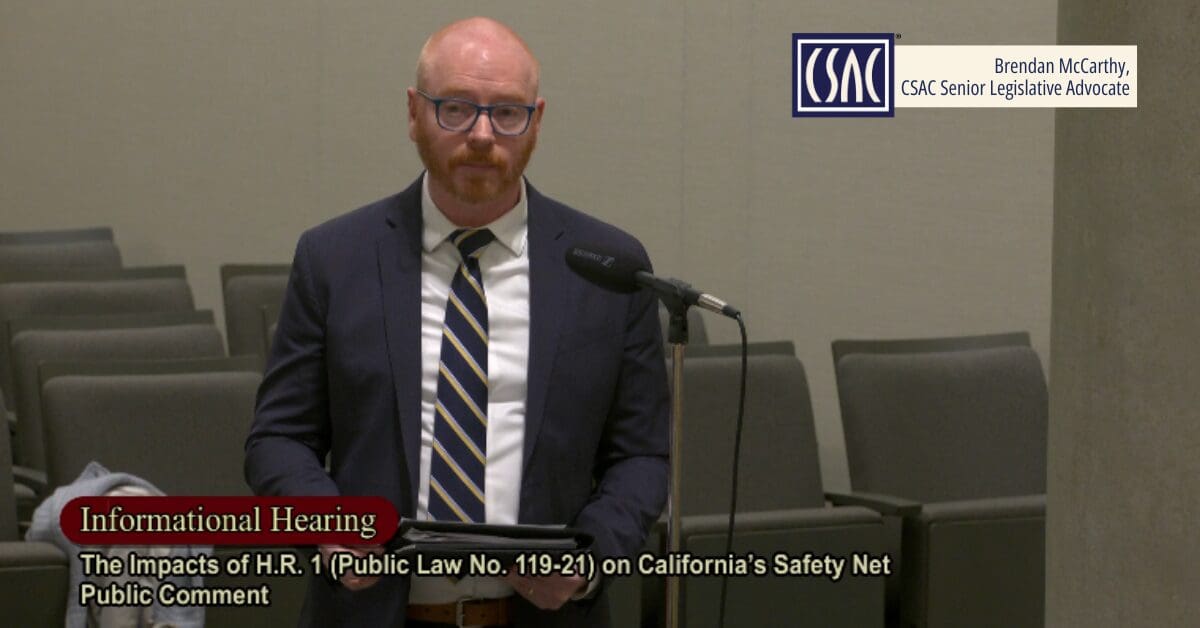
California senators sounded bipartisan alarm Wednesday over the impact of H.R. 1 on county-run safety net programs, citing a new report from CSAC and other county partners that estimates the law could cost counties up to $9.5 billion annually.
During the Senate Budget and Fiscal Review Committee hearing on the federal cuts, state lawmakers and advocates detailed the devastating consequences H.R. 1 could have on programs like CalFresh (SNAP) and Medi-Cal (Medicaid), which provide food and health care to millions of Californians.
In his opening remarks, Committee Chair John Laird referenced the $9.5 billion estimate and called the legislation “the most sweeping disruption to SNAP and Medicaid in the history of these federal entitlement programs.”
Senator Kelly Seyarto also spoke up as a “voice for the counties and cities,” noting that while the federal government shifts costs down to the state, “the state does that to the counties and cities all the time.”
Counties administer Medi-Cal and CalFresh on behalf of the state, serving as the frontline providers of California’s safety net. But as H.R. 1 reduces eligibility and limits access to coverage, counties are left hanging to manage the consequences.
Counties are required by state law to provide basic, medically necessary care to low-income residents who are not eligible for Medi-Cal or lack other coverage.
Brendan McCarthy, CSAC Health & Human Services Advocate, told senators that these county indigent care programs are not comprehensive like Medi-Cal or commercial health plans, and they do not have a dedicated funding source.
Indigent care is “not a substitute for Medi-Cal,” said McCarthy. “The realignment funds that formerly supported those programs were redirected by the state to other purposes, so counties no longer have resources to rebuild those programs.”
Historically, counties relied on 1991 Realignment funding to help cover indigent care. But under AB 85 in 2013, the state redirected much of that funding for other purposes. As H.R. 1 pushes more residents off Medi-Cal and into county indigent care programs, counties face the prospect of absorbing billions in new costs without the funding necessary to support them.
Senator Maria Elena Durazo posed the question that has long been on county leaders’ minds since H.R.1 was enacted: “Who is expected to absorb these costs if counties lack sufficient realignment funding?”
The hearing also focused on another significant H.R. 1 impact. County eligibility workers help vulnerable individuals and families navigate complicated requirements to obtain and maintain essential coverage and benefits. H.R. 1 will impose significant new workload costs on the county eligibility workforce to verify that Medi-Cal and CalFresh enrollees meet new work requirements and to perform more frequent redeterminations of eligibility for these programs.
In the Medi-Cal program, public hospitals and health systems self-finance the non-federal share of costs for the care they provide to Medi-Cal enrollees. H.R. 1 places limits on a primary mechanism through which public hospitals and health systems supplement low Medi-Cal reimbursement rates: State Directed Payments. This will reduce the availability of federal funding to support care provided by public hospitals and health systems.
These cuts will impact access to all patient care services. In many cases, when Californian’s lose access to Medi-Cal, emergency rooms become the only place they can receive medical care, placing a significant strain on public hospitals.
Senator Lola Smallwood-Cuevas emphasized that H.R. 1 “shifts the long-term costs to emergency care, the county indigent health systems and providers we know are already strained.”
The hearing made clear that counties cannot address these funding cuts on their own and need strong partnership with the state to protect the safety net from crumbling.
“The costs are not just lost federal funding, but increases in hunger, poverty, and poor health outcomes for years to come,” said Senator Laird.