

State Lawmakers Echo County Advocacy on Homelessness Funding
Back to News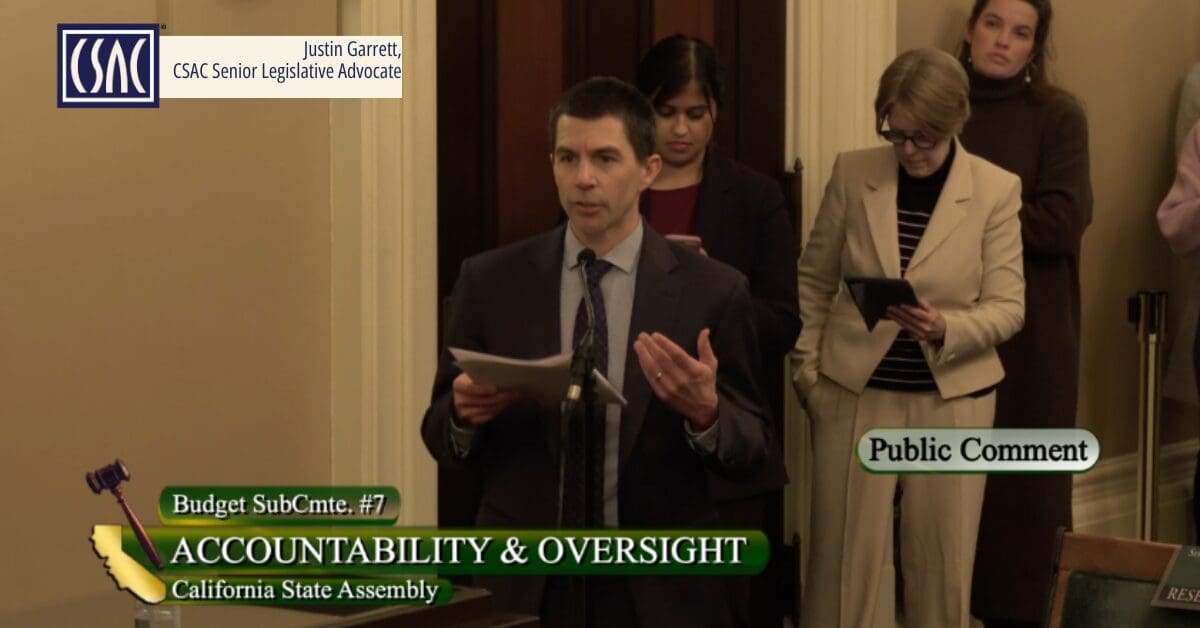
Assembly and Senate budget subcommittees are examining the future of the state’s Homeless Housing, Assistance and Prevention (HHAP) program in the first of many conversations about how California will fund its homelessness response in the 2026-27 budget and beyond.
The governor’s January budget proposal maintains the $500 million authorized last year in HHAP Round 7 — half the level of previous rounds. In a recent coalition letter to state leaders, CSAC urged restoration of HHAP funding to $1 billion annually.
“If we’re seeing progress and we’re getting smarter about our evaluation and accountability and planning,” asked Sen. Christopher Cabaldon, “then why don’t we see an investment for the next round of HHAP in the Governor’s budget?”
More than 90,000 Californians have been placed into permanent housing since 2023 with support from HHAP funds, and initial point-in-time count data shows a 9% reduction in unsheltered homelessness. Lawmakers from both parties emphasized that those outcomes matter – and that the state must build on them.
Assemblymember Gregg Hart said he has “seen firsthand how this program can make a difference,” pointing to more than 800 people in Santa Barbara County who transitioned from homelessness to housing through HHAP-funded programs.
At the same time, members expressed frustration with the slow and unreliable rollout of promised HHAP funds. It’s been more than 600 days since the sixth round of HHAP funding was signed into law, and 55 out of 58 counties haven’t received any of that funding.
Assemblymember Jesse Gabriel said that when resources are authorized but take months to reach communities, “it makes all of our heads want to explode,” adding, “we’ve got to do it quicker.”
Several members acknowledged the need to balance oversight with efficiency. Assemblymember Nick Schultz called for “continuous, stable funding,” cautioning that volatility can be counterproductive to long-term goals. Hart framed the broader tension between the State demanding accountability while local governments question whether funding will roll out each year.
The hearing panels included representatives from four counties – Alameda, Fresno, Riverside, and San Luis Obispo. Counties highlighted their local success with HHAP funding and voiced that they share the goal of accountability but stressed the need for sustained partnership.
CSAC reinforced the key points made by county panelists and outlined statewide needs at both hearings. “This program is an essential component of our collective efforts and our recent success in reducing homelessness,” said Justin Garrett, CSAC Senior Legislative Advocate for Health & Human Services. “Counties are committed to using HHAP funding urgently, effectively and in a coordinated manner to meet the needs of our communities.”
Garrett cautioned that a one-year-at-a-time approach and uncertain funding levels create instability, making it harder to maintain successful programs and enter long-term commitments. Delays between appropriation and disbursement can stall projects and strain local systems. This is amplified as communities face mounting federal uncertainty, with federal funding cuts and policy changes placing over 41,000 people at risk of falling back into homelessness.
As budget negotiations continue, shared goals between policymakers and local leaders remain clear: maintain accountability, strengthen partnership, and ensure communities have the stable resources needed to continue reducing homelessness across California.